
Israeli researchers are using AI to transform cancer treatment and diagnoses
Professor Ron Kimmel is excited about the view of microscopic breast cancer cells on his computer screen.
By Mason Reed ·
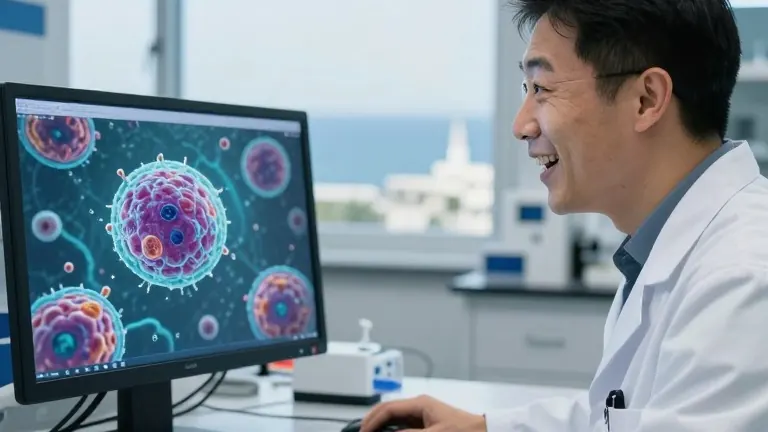
Cutting-edge computational tools are helping Israeli doctors and scientists detect cancers earlier, understand them better and treat them more effectively. From his fourth-floor lab at the Technion-Israel Institute of Technology, Professor Ron Kimmel can see Haifa Bay, the green slopes of Mount Carmel and the distant hills of Galilee. But it’s the view of microscopic breast cancer cells on his computer screen that really excites him.
Kimmel is an expert in computer vision, machine learning, medical imaging and scientific computation. He believes artificial intelligence can dramatically improve the accuracy and efficiency of identifying cancer subtypes, which, crucially, can help oncologists tailor treatments to individual patients.
Kimmel said that AI, which can analyze large amounts of data from clinical trials, is often more accurate than human observations, making it particularly useful in determining how to treat breast cancer.
AI is also the focus of Dr. Debbie Anaby, founder of the Breast Cancer Imaging Lab (BreaCIL) at Sheba Medical Center in Tel Aviv. Her aim is to minimize patient anxiety and slash the number of unnecessary biopsies by using AI-driven computational approaches for analyzing scans.
Also at Sheba is Dr. Talia Golan, who leads the institution’s Pancreatic Cancer Program and the Pancreatic Translational Research Lab. Among the most lethal of all cancers, pancreatic cancer is particularly difficult to treat. And like breast cancer, pancreatic cancer is more common among Ashkenazi Jews due to the increased presence of BRCA1 and BRCA2 mutations.
According to research, about 1 in 40 Ashkenazi Jews carry a BRCA1 or BRCA2 mutation, which is 10 to 20 times higher than in the general population. While having a mutated or defective copy of the BRCA1 or BRCA2 gene can lead to pancreatic cancer, the risk is 2-6 times higher than those who don’t have such mutations.
Golan said the last year or two has seen “leaps and bounds in the field of AI-guided research” when it comes to pancreatic cancer.
Source: Baltimore Jewish Times · original report published