Nobel Physics Prize Goes to IceCube Neutrino Work
Francis Halzen of the University of Wisconsin-Madison was recognized on October 6 for building a detector in Antarctic ice.
By Kavya Sharma ·
The 2026 Nobel Prize in Physics went to Francis Halzen on October 6.
The Royal Swedish Academy of Sciences cited Halzen, a physicist at the University of Wisconsin-Madison, for what it called his "decisive contributions to the IceCube Neutrino Observatory and the discovery of high-energy neutrinos of astrophysical origin."
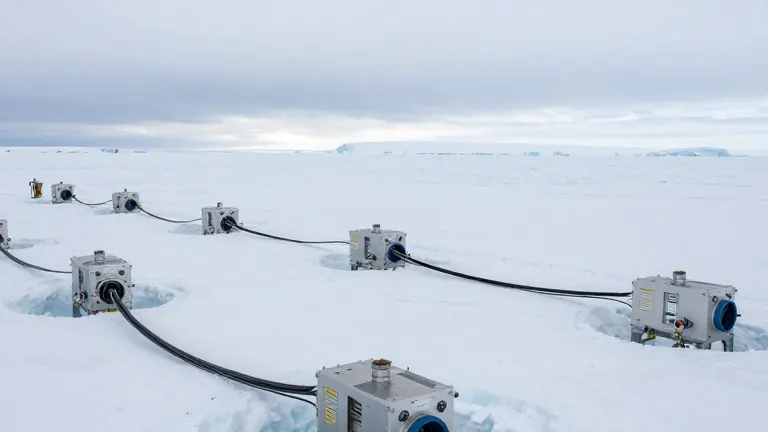
IceCube sits in one cubic kilometer of Antarctic ice and detects three flavors of neutrino: electron, muon and tau. Neutrinos carry no charge and interact weakly, so the detector has to be that large to catch them. When a neutrino does register, it produces a flash of Cherenkov light that traces the particle's path. Andrew Mattson, a physics PhD student whose research uses quantum sensing techniques to hunt for dark matter, said IceCube has traced such paths to sources beyond the solar system and beyond the galaxy.
"That was groundbreaking because that allows you to now learn about these sources that are super super far away," Mattson said, naming black holes, supernovas and quasars. "So it really made this whole new field of neutrino astronomy [possible], where you don't only have to look at photons.. you can now also look at these neutrinos."
Neutrinos first surfaced in the 1930s, when Wolfgang Pauli proposed a neutral particle to account for energy missing from beta decay. Beta-minus decay emits an antineutrino and an electron; beta-plus decay emits a neutrino and a positron. Mattson said a proposed class of decay could show a neutrino acting as its own antiparticle. "If that were to happen, it would explain why we have so much matter and so little antimatter in the universe," he said.
The Nobel committee has taken up neutrino work before. It awarded the 2015 prize for neutrino oscillations and a 2002 prize for detecting cosmic neutrinos from stellar sources including the sun. Mattson said the earlier experiments were sensitive to one neutrino type only, which left a gap between expected and measured counts. "A lot of neutrinos from the sun were switching into other types of neutrinos as they made their way to the Earth, and that's why we weren't observing them," he said.
IceCube has identified sources of high-energy neutrinos from active galaxies. Mattson said a follow-on called IceCube Gen2 would expand the detector to eight cubic kilometers of ice.
Source: The Johns Hopkins News-Letter · original report published
More News · Baltimore news · Report a business · Got a Story?