Baltimore County Readers Watch Israel's Oct. 27 Election
Local observers note high rates of indecision among Israeli voters as polls show no clear path to a majority.
By Mason Reed ·
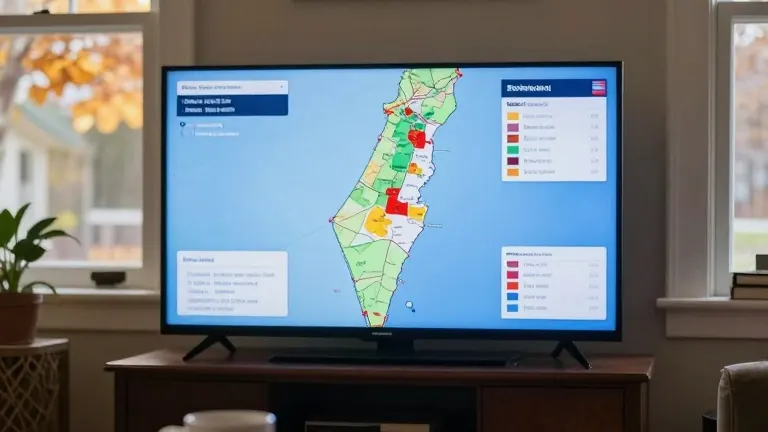
Residents of Baltimore County who follow Israeli politics are watching a tense election day on Oct. 27. Many voters in the region remain undecided, creating uncertainty about who will form the next government.
Polls from Maariv, Channel 12, and Channel 13 estimate that between 5% and 10% of eligible voters have not chosen a party. Mitchell Barak, head of Keevon Global Research, believes the number is higher. He placed the percentage of undecided voters at around 25% in early October.
Barak said these late deciders will have an effect on the outcome. He noted that historically, undecided voters in Israel choose a party on the weekend before election day. Often, these decisions happen after discussions at the Shabbat table.
The election involves 37 parties vying for 120 Knesset seats. Neither the right-wing bloc led by Benjamin Netanyahu nor the center-left bloc led by Gadi Eisenkot is expected to win the 61 seats needed for a majority. This makes the undecided votes critical.
Nat Zitomer, a retired tour guide from Karmiel, described his own hesitation. He leans center-right but struggled to find a suitable party. He said he cannot vote for Haredi parties because they promote draft evasion. He also dismissed Otzma Yehudit and the Religious Zionist Party as too extreme to the right.
Zitomer blamed Prime Minister Netanyahu for the Oct. 7, 2023, Hamas-led invasion. He stated that Netanyahu has outlived his shelf life. Zitomer said he has never been more ambivalent about an election.
Ofer Kenig, a research fellow at the Israel Democracy Institute, offered a different view. He argued that the impact of undecided voters is smaller than polls suggest. He pointed to a Channel 12 poll showing 8% of voters were undecided. However, most of those voters were undecided between parties within the same political bloc.
Kenig said that voting for Netanyahu or Itamar Ben-Gvir is similar because both parties have agreed to form a right-wing coalition. He estimated that less than 1% of undecided voters will cross the political divide. He compared the situation to the U.S. two-party system, noting that the difference is less meaningful in Israel's multi-party system.
Alon Yakter, a political scientist at Tel Aviv University, said some undecided voters feel politically homeless. These voters are often on the soft or center-right. They support settlement expansion but are dissatisfied with the current government's handling of security and social issues. Yakter noted that these voters can choose the Democrats party, which merged Meretz and Labor.
Daniel Meyer, a right-wing voter in the West Bank, said he has not found a party to support. He does not want to vote for Netanyahu until a state inquiry begins. He is considering the new Haredi Public party because it advocates for greater integration into the IDF. Meyer said this party offers real changes needed by Israeli society.
Adele Raemer, a survivor of the Oct. 7 attack in Kibbutz Nirim, said she wants Netanyahu and his coalition partners out of office. She called the current government a disaster. Raemer is looking for a centrist government that will secure borders and assist victims, including hostages and soldiers. She said the government has abandoned the survivors.
Eva Weiss, a writer in Netanya, said she is deeply dissatisfied with the current coalition. She will vote for a party with the best chance of forming a government without far-right or major Haredi parties. Weiss compared voting to Russian roulette. She is trying to determine the best horse to bet on in the post-election horse-trading.
Source: Baltimore Jewish Times · original report published
More News · Baltimore news · Report a business · Got a Story?