Microsoft 365 Outage Prompts Baltimore Writer to Audit Personal Cyber Hygiene
Karen Clay, a local technology writer, used the recent service disruption as a catalyst to update her devices, secure her passwords, and test her data backups.
By Kavya Sharma ·
Karen Clay, a technology and multimedia writer based in Baltimore, completed a series of personal cybersecurity updates following a widespread Microsoft 365 outage. The disruption, which occurred this week, prevented Outlook users from accessing email and other services, prompting Clay to examine her own digital habits.
Microsoft identified the cause as a latent defect in its Windows servers. The company’s post-incident report described the issue as a hidden weakness that remained inactive until specific conditions triggered it. When the defect activated, the affected servers became overwhelmed and unresponsive. Traffic then shifted to other servers, spreading the instability across the system. Microsoft confirmed the event was a technical failure rather than a cyberattack.
Clay noted that the incident mirrored her own approach to device maintenance. For months, she had postponed operating system updates and browser patches, often citing active work sessions or meetings as reasons to wait. She recognized that delaying updates leaves known vulnerabilities open to potential exploitation, even when the device appears to function normally.
The writer also acknowledged weaknesses in her password management. She admitted to reusing a single password structure across multiple websites, adding only minor variations such as numbers or symbols. She had repeatedly deferred enabling multifactor authentication, a process that requires an additional verification step during sign-in, describing the extra step as inconvenient.
Clay compared her personal security gaps to Microsoft’s latent defect. Both relied on a state of apparent normalcy that masked underlying risks. In her case, the risk involved an exposed password or an unpatched program waiting for a specific trigger, such as a convincing phishing message.
To address these issues, Clay implemented several changes. She saved her work and completed all pending updates on her computer. She verified that automatic update settings were active for her operating system and browser. She also confirmed that her security software was current and running.
The writer began replacing her reused passwords with unique ones, storing them in a password manager. She enabled multifactor authentication on her email account first, prioritizing this service because it often manages password resets for other platforms. She then extended the feature to other important accounts.
Clay also reviewed her data backup routine. She discovered that her most recent backup was several months old. She established a schedule for regular backups and tested the process by restoring a file. She noted that while backups do not prevent data intrusion, they facilitate recovery from lost or damaged files.
The recent outage served as a practical lesson for Clay. She stated that she no longer views the absence of technical problems as proof that postponing protection is harmless. She now completes legitimate updates promptly and pauses before clicking links in urgent messages. The Federal Trade Commission advises users to verify suspicious requests by typing known website addresses or calling known phone numbers rather than using links provided in the message.
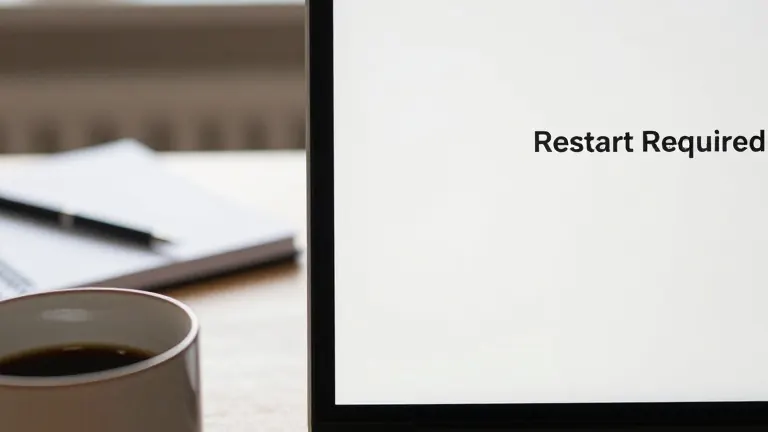
Clay concluded her review by clicking the restart prompt on her laptop. The action marked the end of a period where she had assumed that delaying routine maintenance was a viable strategy for managing her digital environment.
More Tech · Baltimore news · Report a business · Got a Story?